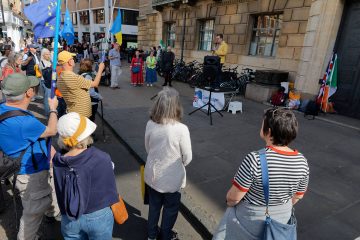
On 23rd June 2026, the 10th anniversary of the Brexit referendum, we held a panel discussion in Magdalene College, Cambridge, to discuss the path back to EU membership.
Our panellists were:
- Molly Scott Cato – Vice Chair, European Movement UK
- James Coldwell – Senior Manager for External Affairs, Best for Britain
- Jonathan Saunders – Head of International, Young European Movement UK
Each of the speakers gave an opening statement, and the discussion was chaired by Paul Browne of Cambridge for Europe.
Watch a recording of the panellists opening statements:
In her opening statement Molly Scott Cato stressed that we are now in an era of intense struggle between autocracy and democracy, and the key role of the EU in defending our rights, asking “who else other than the EU is going to stand up against those forces?” . She also spoke against holding another divisive referendum on the question of rejoining, arguing that stronger civic engagement and a vote in Parliament would be better.
James Coldwell presented data from a new report undertaken by Frontier Economics for Best for Britain, which finds that rejoining the EU is by far the best policy lever avaibable to the UK government to boost the UK’s economy, and also the the option most likely to deliver real electoral dividends, and lowest risk, for progressive parties if they embrace it. He argued that a referendum is likely to be needed to convince the EU that the UK will be a committed EU member.
Jonathan Saunders reminded us that the EU has evolved since the UK left, and that it’s ability to act collectively in response to crises has likely been strenghened by the absence of the UK’s veto.
There was broad agreement on the panel that as campaigners we need to ensure that rejoining the EU is a commitment in party manifestos, particularly the Labour Party manifesto, for the next general election, and that any referendum must be on the negotiated agreement to rejoin the EU.
There was firm agreement among the panellists, and the audience, that if the UK aims to rejoin the EU it must do so wholeheartedly and fully embrace the project for European Unity. No more opt-outs!
Read a longer report in East Anglia Bylines.